

What would change in your day-to-day DeFi workflow if your wallet could reliably tell you the real effect of a transaction before you sign it? That question reframes most wallet choices for serious users. For active traders, strategy managers, and security-conscious operators in the US DeFi ecosystem, small differences in pre-signing visibility, approval management, and hardware compatibility compound into real losses or saved time. This article compares Rabby Wallet against mainstream EVM alternatives and explains the mechanisms behind its security-first features, where it shines, and where it still forces compromise.
I’ll assume you know the broad categories — browser extension vs mobile, custodial vs non-custodial — and focus instead on the practical mechanics that matter: transaction simulation, approval revocation, gas/top-up flows, and integration with hardware and multi-sig infrastructure. These are the levers a power user toggles when reducing operational risk or streamlining multi-chain activity.
How Rabby’s mechanism for stopping “blind signing” works — and why it matters
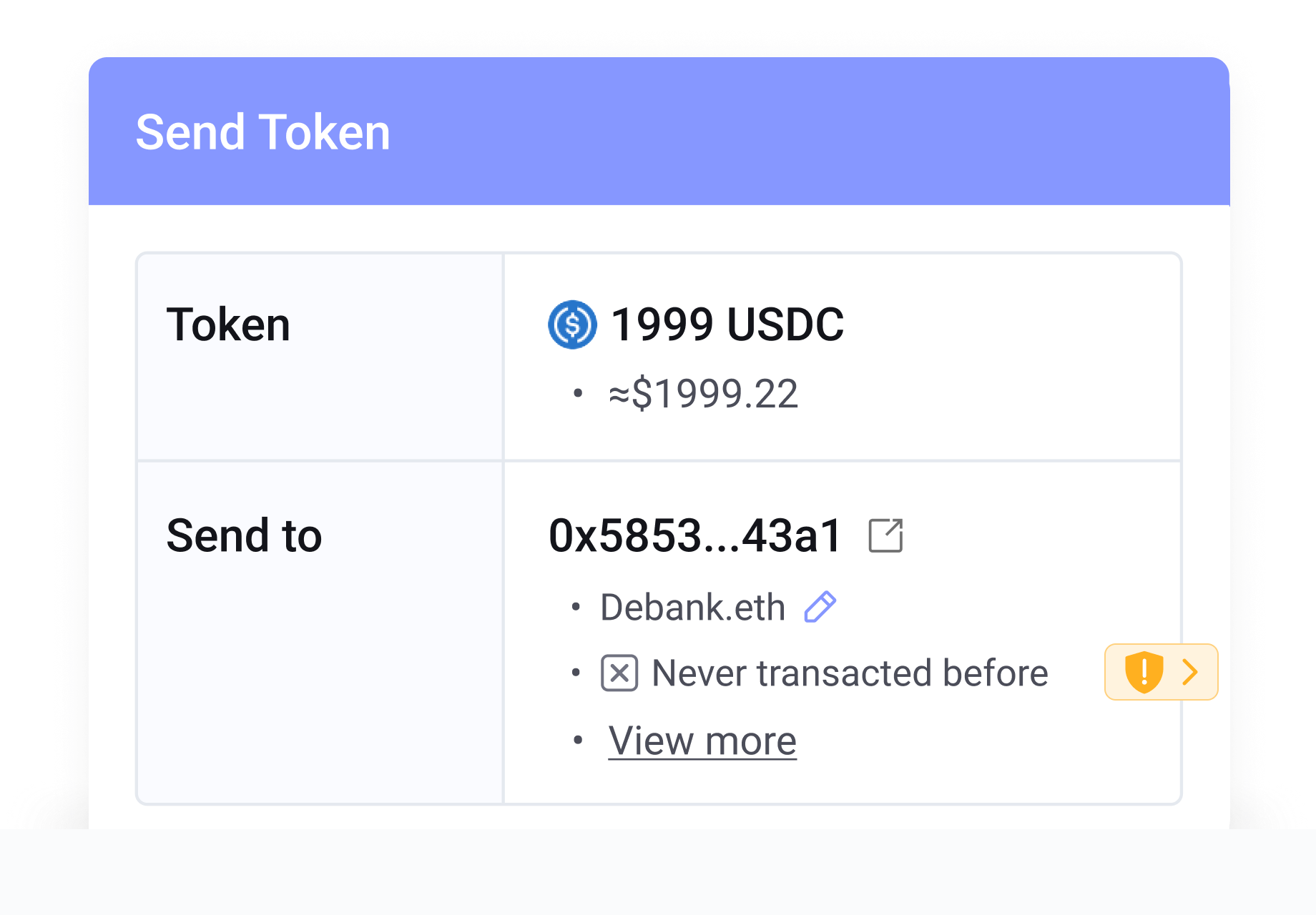
Many wallet-related losses come not from poor key storage but from signing transactions whose net effect the user never fully understood. Rabby addresses this with transaction simulation: before the wallet sends a signature, it executes the transaction call against a local simulator (or a remote node that reproduces state) to estimate exact token balance deltas and gas costs. Mechanistically this is different from superficial warnings: a simulation computes the call result with the current chain state and decodes token transfers, allowance changes, and reverts, allowing the UI to display “you will lose X tokens, gain Y tokens, spend Z gas.”
For a power user, that granular feedback changes workflows. When aggregating complex DeFi steps (zap-ins, permit approvals, multi-hop swaps), simulation surfaces hidden slippage or approval side-effects that would otherwise be invisible until after signing. It is not magic — simulations depend on accurate node state and deterministic execution — but it transforms ambiguous risk into inspectable, often actionable information.
Feature-by-feature: Rabby versus typical alternatives
Below are the trade-offs that generally distinguish Rabby from MetaMask, Trust Wallet, and standard mobile wallets. This is not a feature checklist but a decision-oriented lens: which wallet reduces which operational risk?
Transaction simulation and pre-transaction risk scanning: Rabby implements both simulation and a security engine that flags hacked contracts, suspicious approvals, or nonexistent recipients. Alternatives typically warn on signature types but rarely simulate full token deltas. That gives Rabby a clear edge for preventing blind-sign problems; the trade-off is complexity — simulations can introduce occasional false positives or require network access that slightly slows approval UX.
Approval revocation: Rabby’s native revocation tool lets users enumerate and cancel outstanding token approvals. This matters because many DeFi exploits exploit perpetual allowances. While third-party revocation services exist, an integrated UI reduces friction and the time between discovery and revocation — a practical security gain for high-frequency users.
Hardware wallet and institutional integration: Rabby supports major hardware keys (Ledger, Trezor, Keystone, etc.) and integrates with multi-sig and custody platforms like Gnosis Safe and Fireblocks. If your operational model demands multi-actor signing or cold-key custody, Rabby’s compatibility reduces the need for bespoke tooling. The trade-off: some enterprise flows still prefer dedicated custodial UI primitives that other vendors provide as part of their platforms.
Automatic network switching and cross-chain tooling: Rabby auto-switches networks based on the dApp, supports 90+ EVM chains, and offers a cross-chain gas top-up feature (send ETH or BNB to other chains to fund gas). For multi-chain traders, that removes small but frequent frictions. The limitation to remember: network auto-switching is helpful but can mislead users if a malicious dApp requests a network change; reliance on simulation mitigates but does not eliminate that class of attack.
Missing pieces: Rabby does not offer an in-wallet fiat on-ramp or native staking features. If you routinely buy crypto with USD in-wallet or stake tokens inside the wallet UI, you’ll need external services. For many US-based power users who already use exchanges or staking providers, this is a tolerable gap; for newcomers it raises onboarding friction.
Security history and realistic caution
No wallet is risk-free. Rabby’s history includes a 2022 exploit of a Rabby Swap contract (~$190k loss), after which the team froze the contract, compensated users, and strengthened audits. That incident illustrates a general principle: application-level contracts, even those associated with wallet teams, are attack surfaces separate from key management. Rabby’s open-source codebase and post-incident response are positive signals, but they do not erase systemic risk—especially in DeFi, where composability means one compromised contract can propagate losses.
Put another way, simulations and revocation tools reduce certain classes of human and contract risk but they cannot prevent novel protocol-level exploits, front-running at the DEX level, or supply-chain attacks on dependencies. Always treat wallet security as layered: good simulation + hardware keys + careful contract vetting + minimized approvals yields substantially better outcomes than any single control alone.
Practical decision heuristics for US DeFi power users
Here are re-usable heuristics you can apply when choosing or configuring Rabby (or comparing it to alternatives):
- If you routinely batch complex transactions across chains, prefer wallets with transaction simulation and cross-chain gas top-up — this reduces failed sequences and stranded assets.
- If your threat model includes compromised front-end dApps or social-engineered approval requests, prioritize integrated approval revocation and pre-transaction risk scanning.
- If your organization requires multi-sig sign-off or custody, ensure wallet compatibility with enterprise tools (Gnosis Safe, Fireblocks). Rabby supports these integrations, which lowers integration overhead.
- If you depend on in-wallet fiat or native staking for operational simplicity, recognize Rabby’s current gaps and factor in additional services.
For readers ready to test the extension in a controlled way, the project offers browser and desktop clients and supports hardware wallets. See the official extension page for download links and documentation: rabby wallet extension.
Where Rabby is likely to improve and what to watch
Given the product’s architecture and industry incentives, reasonable near-term developments to monitor include built-in fiat ramps via third-party partnerships, expanded staking integrations, and richer enterprise UX for governance and treasury management. What would change the calculus? Evidence of reduced false positives in simulation (improving UX), or a robust, audited in-wallet fiat on-ramp, would lower barriers for power users who also need quick capital flows from USD.
Conversely, the wallet’s advantages could be eroded if competitors embed similar simulation or revocation features, or if new cross-chain middleware reduces the need for wallet-side gas top-ups. The signal to watch is cross-wallet adoption of pre-sign simulation as a baseline expectation; if that becomes standard, other differentiators—speed, UX, and institutional integrations—will matter more.
FAQ
Does Rabby replace hardware wallets or just complement them?
Rabby complements hardware wallets; it integrates with devices like Ledger and Trezor so that the private key never leaves secure hardware while Rabby provides the UI, simulation, and approval management. For high-value accounts, using Rabby as the UI layer with a hardware signer is a best-practice pattern.
Can Rabby’s simulation be fooled or produce incorrect results?
Simulations rely on current node state and deterministic execution; they can be incorrect if the chain state changes between simulation and inclusion, or if the simulator does not exactly match on-chain execution (edge cases in gas refunds, oracle responses, or miner-executed MEV adjustments). Simulations are a strong safety net but not a formal guarantee.
Is Rabby safe to use in the US given regulatory uncertainty?
Rabby is a non-custodial, open-source wallet whose core functions—key management, transaction signing, simulation—are client-side. Regulatory changes can affect third-party services (fiat on-ramps, KYC providers) more than the wallet itself. Institutional users should map compliance requirements separately; technical controls in Rabby do not substitute for legal obligations.
How should I combine Rabby with other security tools?
Use layered defenses: keep high-value keys in hardware wallets integrated with Rabby, limit approvals and use the revocation tool regularly, separate hot and cold wallets for operational tasks, and run transactions through simulation on a private node when handling very large sums. These practices address human error, contract risk, and key compromise collectively.
